
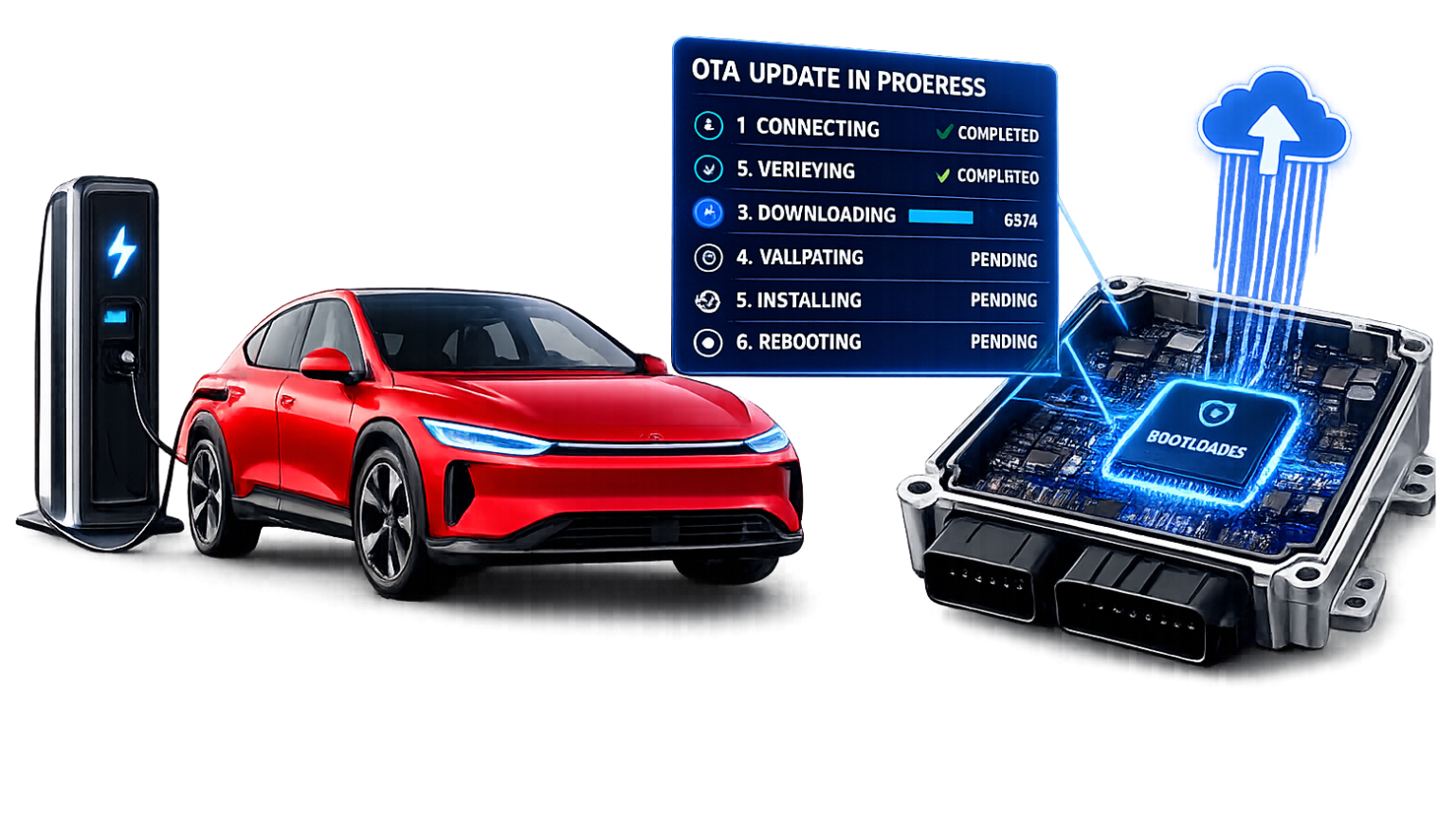
Flash Bootloader Overview
Modern vehicle ECUs require periodic firmware updates throughout their lifecycle, whether in the field, at service centers, or during end-of-line programming. A poorly implemented bootloader can result in bricked ECUs, failed production lines, and costly field campaigns.
ElectRay’s eLite Flash Bootloader is a secure, compact, and highly configurable bootloader designed for reliable in-vehicle ECU reprogramming. Built on industry standards including UDS (ISO 14229) and J1939, it supports CAN-based flashing workflows and integrates seamlessly with both AUTOSAR Classic and non-AUTOSAR ECU software architectures.
Designed for resource-constrained microcontrollers, the eLite.FBL delivers robust checksum validation, seed/key-based security, and a small memory footprint, making it suitable for cost-sensitive ECU platforms without compromising on reliability or security.
2+ Years, Zero Bugs: Engineering You Can Trust
Our automotive bootloader has delivered zero reported bugs since 2023 across deployed production programs, supporting reliable ECU firmware updates in real-world mobility environments. Designed for modern vehicles, it ensures safe and secure ECU reprogramming, robust flash memory integrity, and dependable diagnostics communication, enabling OEMs and Tier-1s to maintain reliable software updates and long-term vehicle performance throughout the mobility lifecycle.
Key Features
- Support for CAN and CAN-FD with UDS-based flashing
- Configurable architecture to align with OEM-specific workflows and security mechanisms
- Compatible with AUTOSAR Classic and non-AUTOSAR environments
- Optimized for small-footprint ECUs with configurable memory usage
- Reliable checksum validation and flash memory integrity management
Key Capabilities
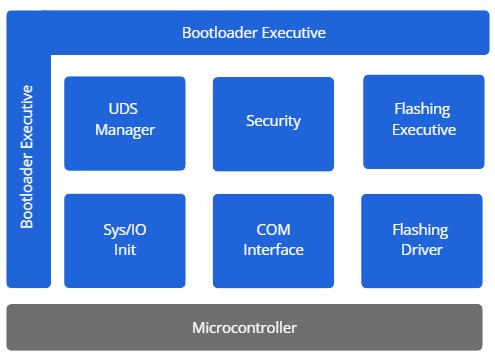
Software Package
ElectRay’s Flash Bootloader is delivered as a complete, integration-ready solution:
- Bootloader Core: Integrated flashing logic for reliable ECU reprogramming
- Diagnostic & Communication Support: UDS (ISO 14229 Unified Diagnostic Services) or J1939 over CAN / CAN-FD
- Flash Drivers: Optimized drivers for efficient and safe memory operations
- Communication Drivers: CAN / CAN-FD drivers for reliable data transfer
- Security Implementation: Seed/key-based access control for secure flashing
- ECU Flashing Tool : PC-based tool for executing flashing sequences and validating ECU programming
ElectRay’s Flash Bootloader vs Typical Flash Bootloaders
Choosing the right bootloader impacts ECU reliability, OTA readiness, and long-term maintainability. The table below compares ElectRay’s Flash Bootloader against typical flash bootloader implementations available in the market.
| USP Area | ElectRay Secure Flash Bootloader | Typical Flash Bootloaders in Market |
|---|---|---|
| ARCHITECTURE & FLASHING | ||
| Dual-bank A/B atomic swap | Atomic A/B partition swap with automatic rollback on power loss or failed update. A valid, bootable image always exists on the ECU. | Many bootloaders use single-bank designs. Dual-bank or fail-safe support varies and often requires additional integration effort. |
| Transport protocol support | Supports CAN, CAN-FD, J1939 and J1939-FD, covering both legacy ECUs and high-speed EOL factory flashing. | Protocol support available but may require configuration or additional modules. |
| Anti-rollback protection | Prevents firmware downgrade attacks. Older, vulnerable firmware versions cannot be reinstalled. | Software-only version checks are bypassable. Anti-rollback support depends on implementation and security configuration. |
| OTA / FOTA ready | Serves the full ECU lifecycle from production EOL flashing to field FOTA. Pairs natively with ElectRay’s FOTA Solution for multi-ECU cloud-orchestrated campaigns. | Most bootloaders target bench or EOL flashing. Field OTA requires additional middleware from a separate vendor, adding integration risk at the most security-critical layer. |
| SECURITY | ||
| Secure boot & signature verification | Every firmware image is verified against an OEM specific keys before execution. | Secure boot supported but often requires additional setup and configuration. |
| HSM integration | Direct integration with on-chip HSMs if available in Hardware platform. | HSM support varies by platform and may require customization. |
| ISO/SAE 21434 & AIS-189 aligned | Aligned with ISO/SAE 21434 and AIS-189 for automotive cybersecurity practices. | ISO/SAE 21434 is referenced broadly but rarely documented at product level. |
| STANDARDS COMPLIANCE | ||
| Code quality & standards compliance | ISO 14229 UDS reprogramming services and MISRA-C compliant. | Code quality varies across vendors and implementations. |
| AUTOSAR Classic compatible | Runs in AUTOSAR Classic BSW and conventional non-AUTOSAR environments. | AUTOSAR compatibility available but may require additional configuration. |
| ISO 26262 aligned | Aligned with ISO 26262, supporting safety-oriented development processes. | Safety alignment depends on project-level processes and integration. |
| EV / SDV, TOOLING & ECOSYSTEM | ||
| EV / SDV architecture ready | Designed for EV and SDV architectures with scalable support. Production-deployed across 2W and passenger EV programs in India and Europe. | Most bootloaders are qualified for traditional distributed ECU architectures. EV/SDV readiness varies and often depends on system integration. |
| ECU flashing tool (Windows) | Windows-based ECU Flashing Tool built specifically for the Secure Flash Bootloader. No third-party tool purchase or additional licence required. | Most vendors rely on third-party tools, requiring customers to separately procure, licence and maintain them, adding cost and a second support relationship. |
| Ecosystem availability | Integrated with diagnostics, Secure Flash Bootloader and FOTA under one vendor, reducing integration effort. | Requires multiple tools, vendors or project-based integration. |
Reliable ECU Flashing Workflow
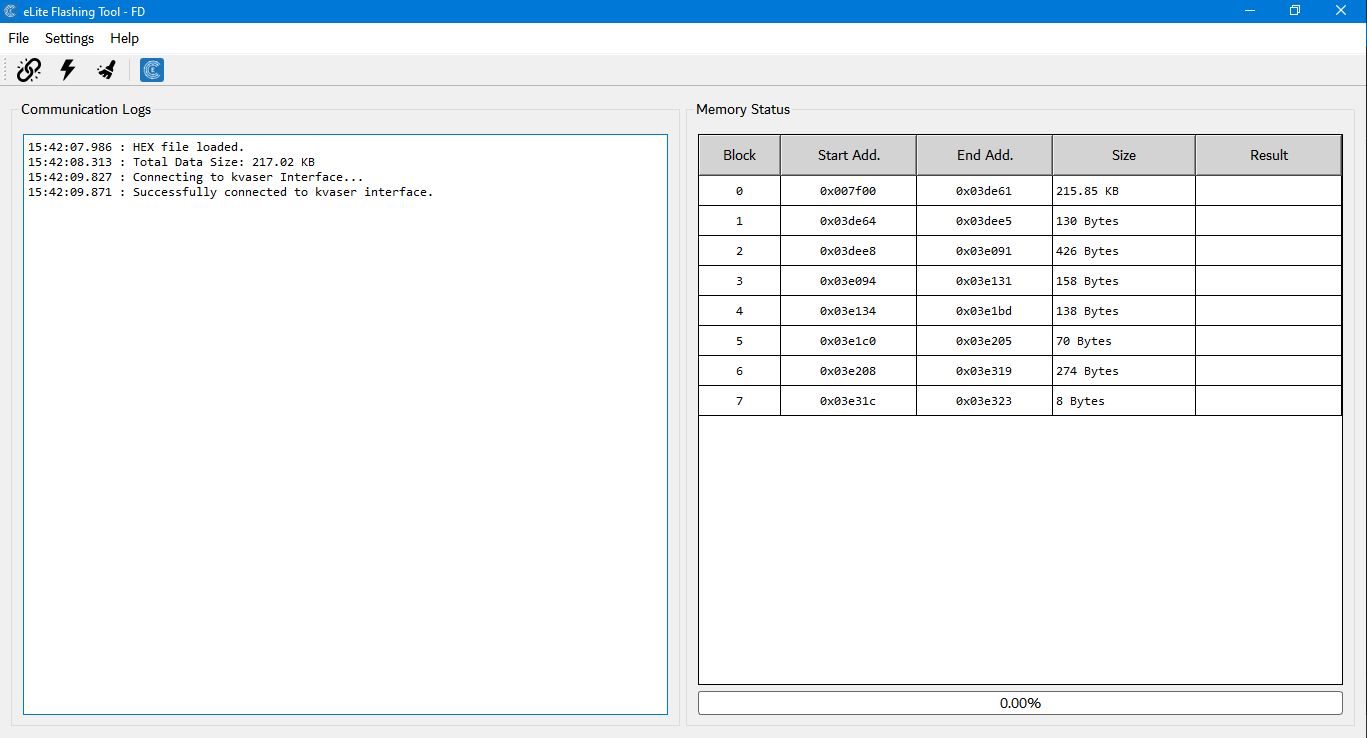
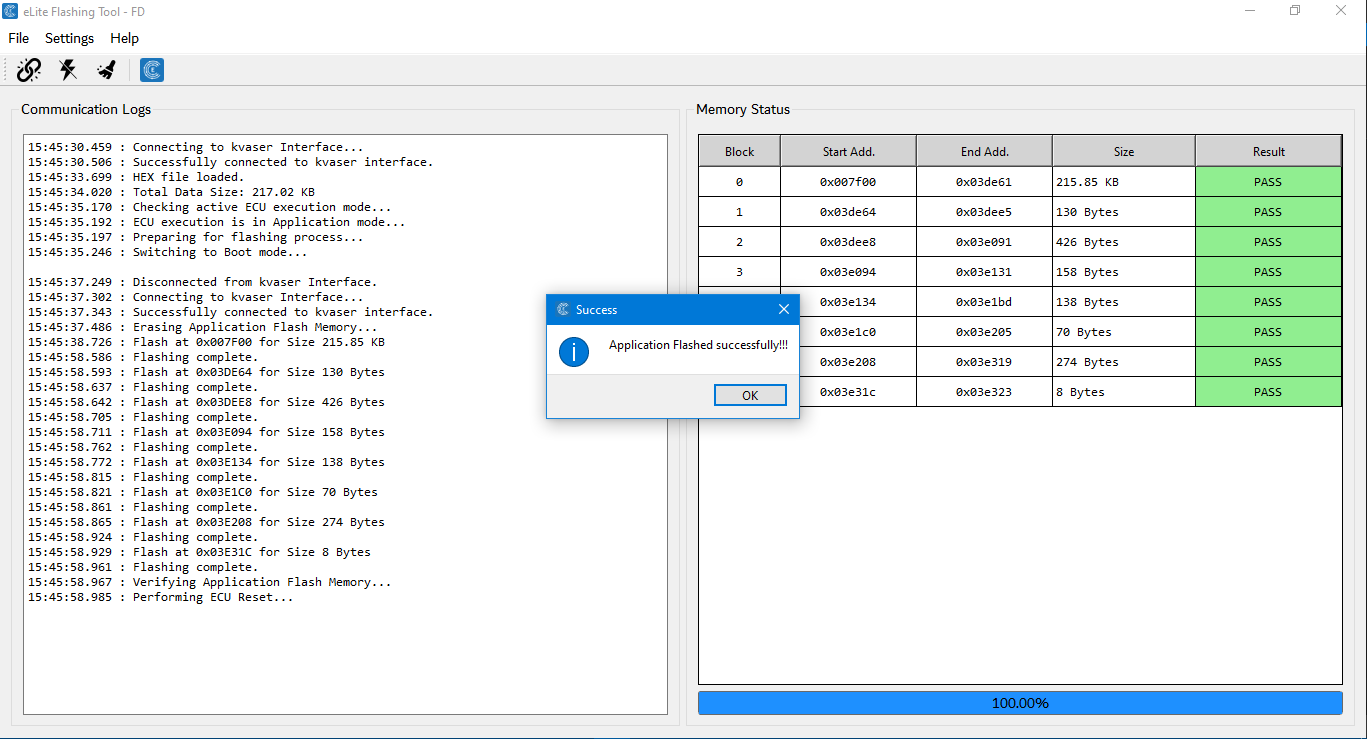
Execute ECU flashing with a validated and deterministic workflow using the flash bootloader solution. From secure connection and memory erase to block-wise programming and verification, each step is handled with precision and reliability.
Real-time logs and clear memory status provide full visibility throughout the process, enabling confident and error-free ECU reprogramming across development and production environments.
Deployment & Support Ecosystem
Supported Platforms
- Compatible with leading automotive microcontrollers including
- Infineon
- Renesas
- NXP
- Microchip
- STMicroelectronics
- Texas Instruments
- Designed to operate across diverse ECU architectures and hardware platforms