
Functional Diagnostic Requirements Definition for Software-Defined Vehicles


Client

OEM

Industry
How ElectRay Standardized Functional Diagnostics Across Multi-Domain ECUs for SDV Readiness
Technologies
The requirements definition was supported using:
- Software Platform: AUTOSAR & Non-AUTOSAR architectures
- Hardware/ECU: Hardware-independent
- ECU Diagnostic Inputs: Supplier-provided CDDs
- Systems Engineering: Vector PREEvision, DFMEA, OEM FTS
- Safety & Security Inputs: ISO 26262, ISO 21434
- Documentation & Traceability: OEM workflows & structured revisions
Business Need
The OEM needed a standardized and reusable Functional Diagnostics (FD) requirements framework for its next-generation SDV program across Body, Cockpit, Connectivity, and Chassis domains. Without unified diagnostic behaviors, the platform risked inconsistencies in serviceability, compliance, OTA readiness, and multi-supplier integration.
ElectRay was engaged to define a unified diagnostic baseline, enabling consistency, scalability, and SDV readiness across all ECUs.
Description
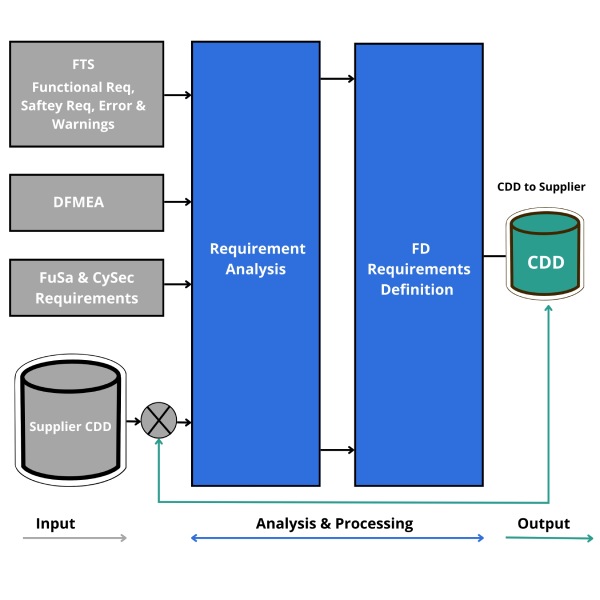
ElectRay defined Functional Diagnostic requirements across Body, Cockpit, Connectivity, and Chassis domains, ensuring each ECU included clear, consistent, and SDV-ready diagnostic definitions aligned with OEM standards, system behavior, and supplier documentation.
Challenge
Creating harmonized FD requirements across multiple domains demanded deep system insight and close coordination.
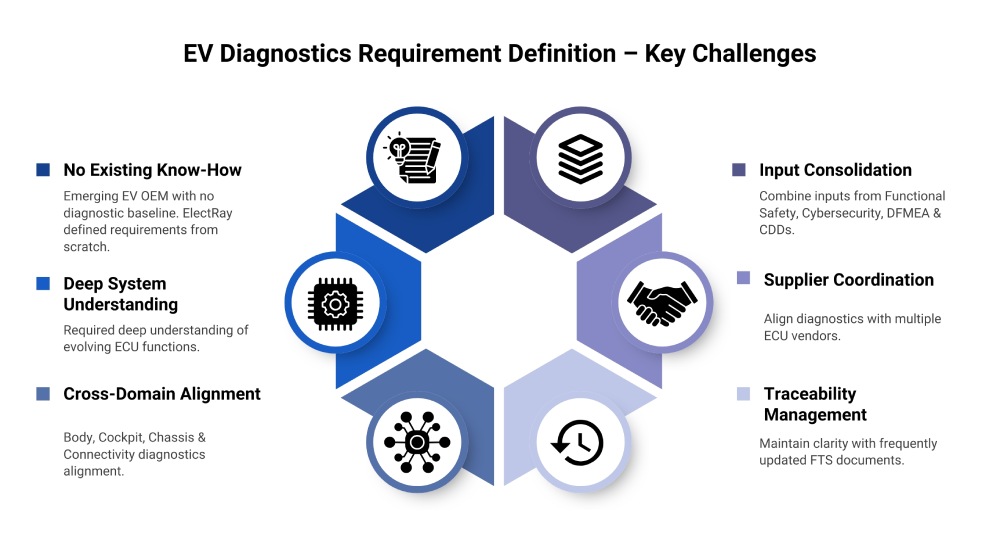
Key challenges included:
- Lack of Existing Know-How: As an emerging EV OEM, there was no diagnostic or domain baseline available, requiring ElectRay to define requirements from the ground up.
- Deep System Understanding across evolving ECU functions.
- Cross-Domain alignment for Body, Cockpit, Chassis, and Connectivity.
- Input Consolidation from Functional Safety, Cybersecurity, DFMEA, and CDDs.
- Supplier Coordination across multiple ECU vendors.
- Traceability with frequently updated FTS documents.
Solution
ElectRay established a structured, scalable, and traceable FD requirements process aligned with SDV expectations.
Key solution steps:
- Developed Layer 1 (L1) Vehicle Requirements and Layer 2 (L2) System Requirements for Functional Diagnostics using FTS, Functional Safety, Cybersecurity, DFMEA, and CDD inputs.
- Delivered diagnostic monitors, CDD-based parameter mappings, and ECU-level FD specifications.
- Conducted iterative reviews with OEM system engineers ensuring clarity, correctness, and alignment.
- Collaborated closely with ECU suppliers to validate diagnostic items and interfaces.
- Maintained and updated FD requirements through successive FTS revisions.