3 Minutes Read
India’s grid-scale energy storage market is moving from pilots to core infrastructure at speed. The CEA projects 74 GW / 411 GWh of storage capacity by 2032, yet only 219 MWh was operational as recently as mid-2024. Two VGF schemes target 43 GWh of BESS capacity backed by Rs 9,160 crore, a PLI programme of Rs 18,100 crore supports domestic cell manufacturing, and Energy Storage Obligations mandate utility procurement (Ministry of Power, 2025). In June 2025, IndiGrid commissioned India’s first regulated utility-scale standalone BESS, a 20 MW / 40 MWh facility in Delhi.
Globally, BESS deployments are expected to exceed 500 GWh annually by 2030, highlighting the scale at which energy storage is becoming critical infrastructure. The embedded software engineering challenge at the heart of every deployment is substantial, and it closely mirrors the complexity that automotive engineers have been solving for decades.
The Architectural Leap: From Vehicle ECU to BESS Hierarchy
A vehicle BMS monitors and protects individual battery cells within a single pack. A BESS coordinates hundreds of battery racks, each with its own BMS, under a single Energy Management System (EMS) serving the grid. This is not a scale difference; it is an architectural one. BESS firmware must span four hardware tiers simultaneously:
- Cell-level BMS: Voltage, temperature sensing, and active cell balancing
- Rack / Module BMS: Fault isolation, inter-rack data aggregation, and state-of-charge normalisation
- System Controller: State machine management, EMS interfacing, and grid dispatch command execution
- Cloud / EMS Layer: Remote monitoring, performance analytics, and firmware update orchestration
Each tier requires its own RTOS or bare-metal firmware, communication middleware, and diagnostic stack. This hierarchical architecture directly mirrors the zonal E/E structures now emerging in software-defined vehicles, where domain controllers, zone ECUs, and HPC-based central computers each run independent firmware layers coordinated by a common software backbone.
BESS is effectively evolving into a software-defined energy platform, where system behaviour is continuously shaped by firmware updates, data-driven control strategies, and cloud orchestration. This mirrors the transformation already underway in automotive Software-Defined Vehicles.
Communication Protocols: The Hidden Complexity
Protocol diversity is one of the most underestimated BESS embedded software challenges. At the cell and rack level, Modbus, CAN, CANopen, and RS-485 handle BMS data. At the system controller level, IEC 61850 governs grid-side SCADA integration, and DNP3 handles energy management command and telemetry for DC-coupled systems. An EMS gateway ECU must bridge all of these simultaneously, translating between rack-level proprietary protocols and grid-side open standards in real time, a firmware engineering challenge with no off-the-shelf solution.
An EMS gateway ECU must bridge all of these protocols simultaneously. It translates between rack-level proprietary communication and grid-side open standards in real time. This is a non-trivial firmware engineering challenge with no true off-the-shelf solution.
Getting this stack wrong means data latency, grid response failures, and compliance audit failures.
BMS and BESS Diagnostics: The Automotive-Grade Advantage
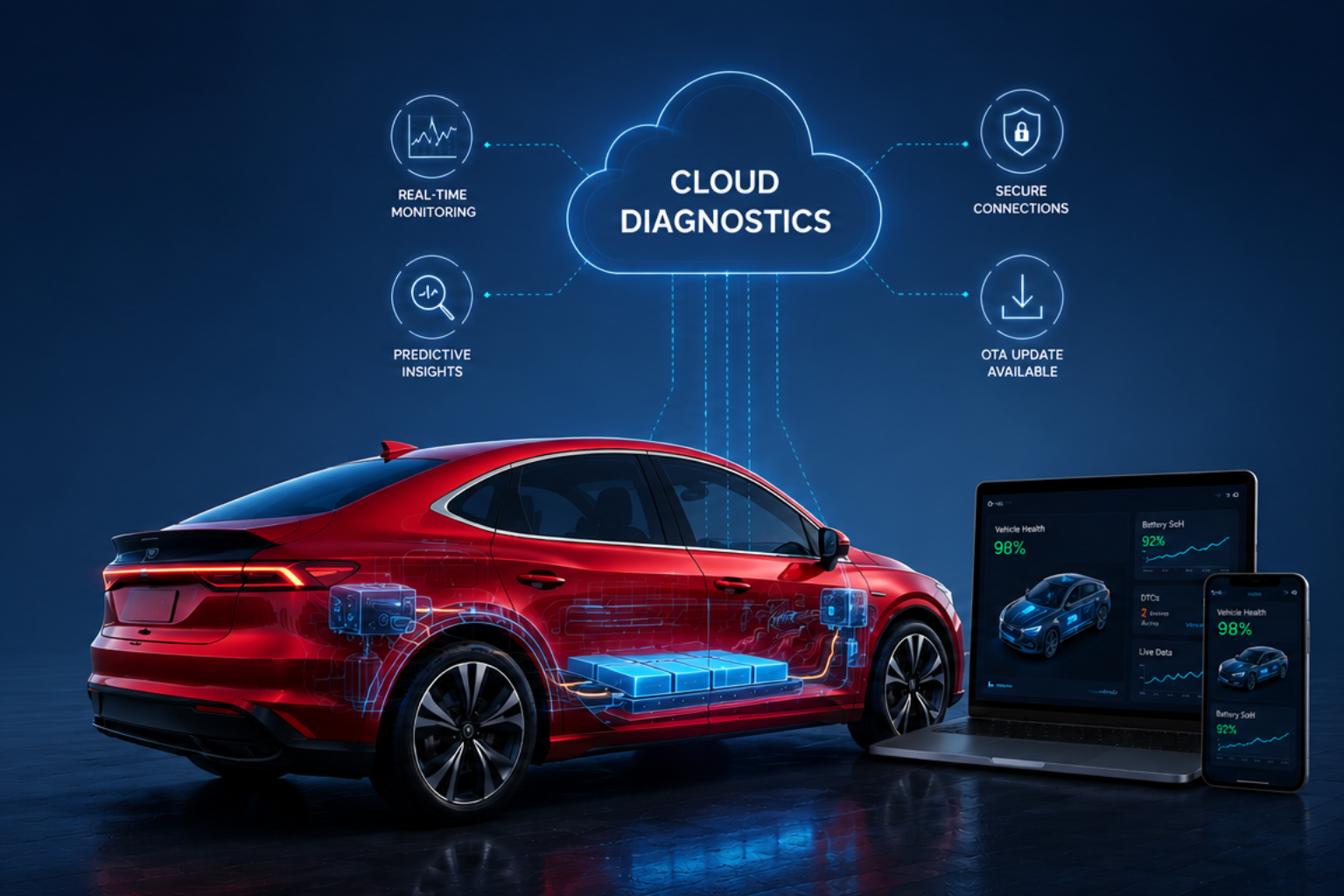
Every tier of the BESS hierarchy continuously generates fault data, health parameters, and status information that must be structured, communicated, and acted upon in real time. Yet most BESS installations today rely on proprietary or Modbus-based diagnostic approaches with no standardised fault classification, no structured fault memory, and no interoperability with standard service tools. A cell voltage imbalance or thermal anomaly that goes undetected can cascade into a rack-level fault, a forced shutdown, and a grid penalty event. Diagnostic maturity is operational risk management at grid scale.
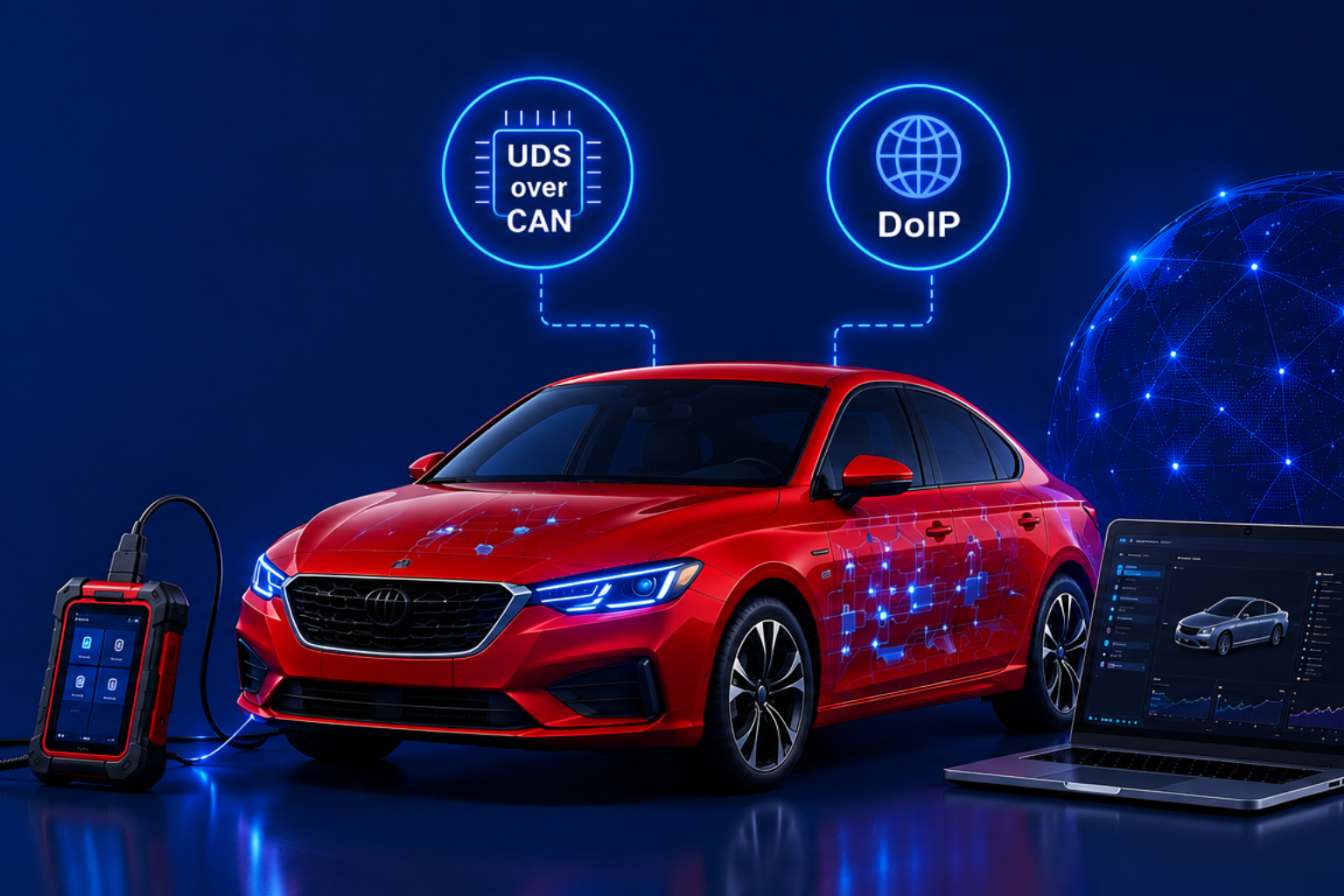
Standards such as UDS (ISO 14229) provide a structured framework for:
- Structured fault reporting: DTC-based fault classification covers BESS fault categories naturally: cell over-temperature, rack isolation fault, contactor weld, insulation resistance failure, and charge limit violation.
- Live parameter monitoring: Routine data access services read SoC, SoH, pack voltage, cell temperature, and current in real time from BMS ECUs at every rack tier, using the same service IDs as automotive ECUs and compatible with standard diagnostic tooling.
- ECU identification and configuration tracking: In multi-vendor rack environments, tracking firmware versions, hardware configurations, and calibration parameters per unit is critical for maintenance and compliance. UDS provides standardised ECU identification services that make this tractable at scale.
- Secure diagnostic sessions: Authentication before accessing sensitive configuration or calibration parameters protects BESS controllers from unauthorised access, aligned with the cybersecurity requirements of IEC 62933 and India’s CEA draft safety framework.
For EV-specific parameters that carry directly into BESS, SAE J1979-3 (ZEVonUDS) extends diagnostic coverage to battery State-of-Health, thermal performance metrics, and charge state parameters, the same data that grid operators and fleet managers need for dispatch planning, warranty management, and degradation forecasting.
ElectRay’s UDS Stack provides production-grade diagnostic infrastructure applicable to BMS and BESS controller ECUs at every system tier, while the ZEVonUDS Stack extends coverage to EV-specific and energy-storage-specific parameters.
FOTA in BESS: Zero Downtime, Maximum Complexity
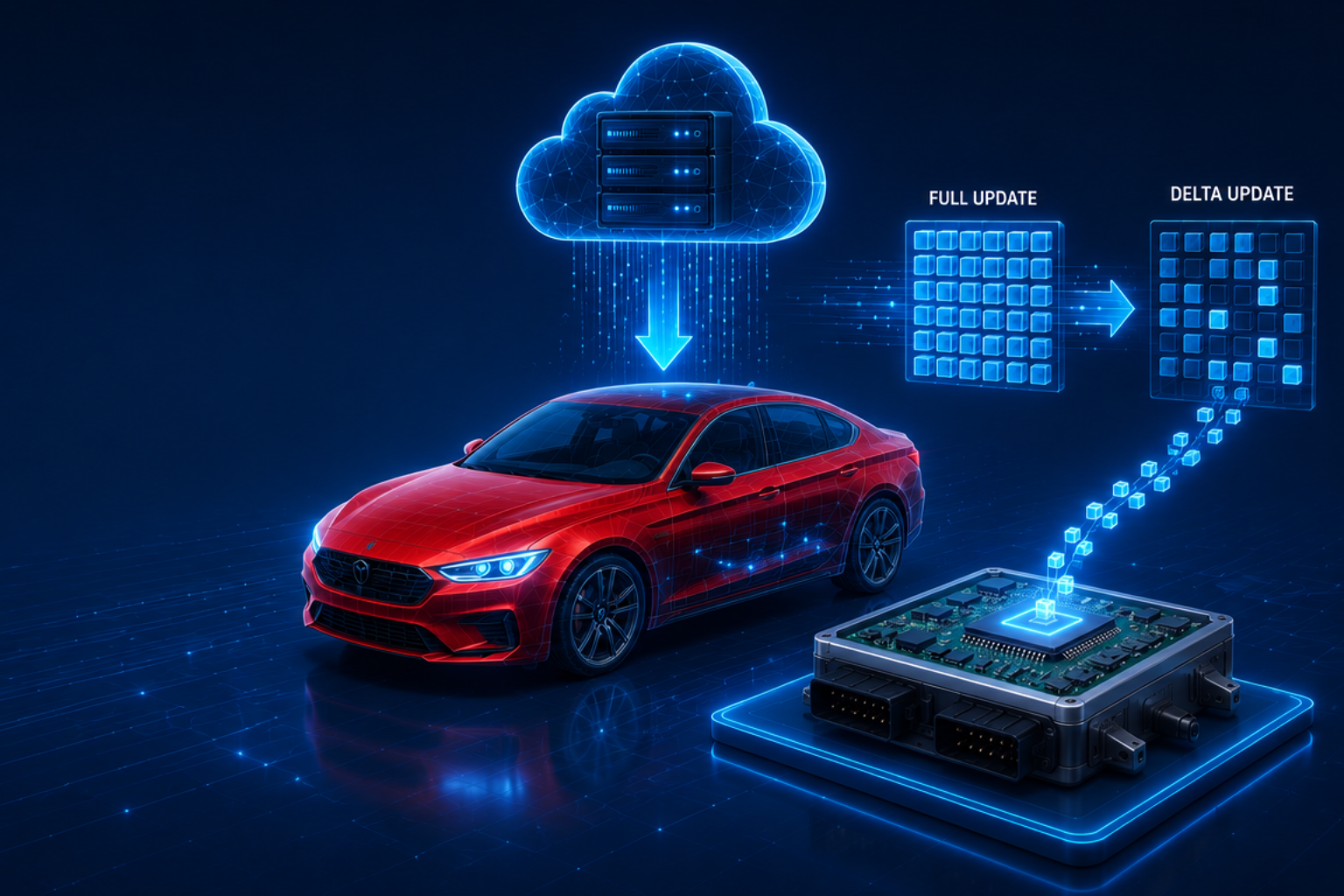
A utility BESS may serve grid frequency response contracts 24/7. Unlike an EV parked overnight, it cannot be taken offline for firmware updates. FOTA is essential for patching vulnerabilities, updating SoC/SoH algorithms, and maintaining regulatory compliance without field dispatches. The key engineering challenges are:
- Orchestration at scale: Coordinating updates across hundreds of heterogeneous ECUs with mixed hardware revisions and firmware versions simultaneously
- Zero-downtime staging: Sequencing updates during low-activity windows in coordination with the EMS and grid operator
- Partial update resilience: Full recovery from power loss or network failure mid-flash, with automatic rollback to the last valid firmware state
- Cryptographic verification: Every firmware image authenticated before execution, across every rack controller in the system
ElectRay’s FOTA Solution delivers secure, rollback-safe over-the-air firmware delivery purpose-built for complex embedded systems, with multi-ECU orchestration and partial-update resilience designed for large-scale, always-on deployment environments.
Secure Bootloaders: The Foundation of BESS Firmware Integrity
The bootloader is the first software to execute on any BESS controller and its most security-sensitive component. A compromised bootloader can render an entire battery rack inoperable or create unsafe grid-side conditions. BESS bootloaders must deliver a secure boot chain with hardware root of trust, cryptographic firmware signature verification, A/B partition management or golden-image fallback ensuring a valid boot state always exists, autonomous fault recovery for unmanned remote installations, and audit logging of every flash event for compliance and post-incident forensics.
ElectRay’s Secure Flash Bootloader is a production-grade, automotive-proven stack with configurable secure boot, A/B image management, multi-protocol download interfaces, and full audit logging, deployable from rack controllers to master system ECUs.
Safety, Cybersecurity and Standards
Grid-tied BESS installations are classified as critical infrastructure and are prime targets for cyberattack; a compromised BESS could destabilise local grid segments or cause thermal events in densely packed rack systems. The applicable standards framework spans IEC 61508 for functional safety integrity levels, IEC 62933 for BESS-specific electrical safety and performance requirements, and ISO/IEC 27001 for information security management. India’s CEA has proposed a dedicated BESS safety framework mandating fire and explosion protection, automatic emergency shutdowns, hazard detection systems, and mandatory third-party safety audits every five years (CEA Draft, 2025). The automotive industry’s ISO 21434 cybersecurity engineering methodology provides a directly applicable threat modelling and security-by-design framework for BESS programs.
ElectRay’s Cybersecurity and Functional Safety engineering services, aligned with ISO/SAE 21434 and ISO 26262, provide a methodology bridge to BESS security and safety requirements.
AI-Driven EMS and the Second-Life Battery Challenge
Two emerging trends add new embedded software complexity. AI-driven EMS applies adaptive SoC/SoH estimation and predictive degradation modelling, demanding higher-fidelity, lower-latency data from every BMS tier, pushing requirements up the firmware stack. Second-life EV batteries repurposed for stationary storage create mixed-chemistry rack configurations with varying SoH baselines and different thermal thresholds, adding BMS firmware complexity that standard single-chemistry stacks cannot handle without targeted engineering.
In parallel, digital twin models and lifecycle analytics are emerging as critical tools for simulating BESS behaviour, predicting failures, and optimising performance across multi-year deployments.
Automotive-Grade Software for the Energy Storage Era
The embedded software complexity of a utility-scale BESS, spanning hierarchical firmware, multi-protocol communication, FOTA orchestration, and secure bootloaders, is not new territory. It is the same class of problem that automotive embedded engineers have been solving across vehicle ECU networks for two decades.
India’s BESS deployment pipeline, backed by Rs 9,160 crore in VGF funding and a CEA target of 236 GWh of BESS by 2031-32, will demand embedded software teams that can bring that automotive discipline to grid-scale energy storage. Teams that do will build systems that are safer, more maintainable, and ready for the operational demands of India’s evolving grid.
The transition from BMS to BESS is not just a scale problem; it is a system orchestration challenge. As energy storage systems become central to grid stability, embedded software becomes the defining factor for safety, reliability, and operational efficiency.
Teams that apply automotive-grade software discipline to BESS development will be best positioned to build systems that are secure, scalable, and ready for continuous operation in a software-defined energy ecosystem.